
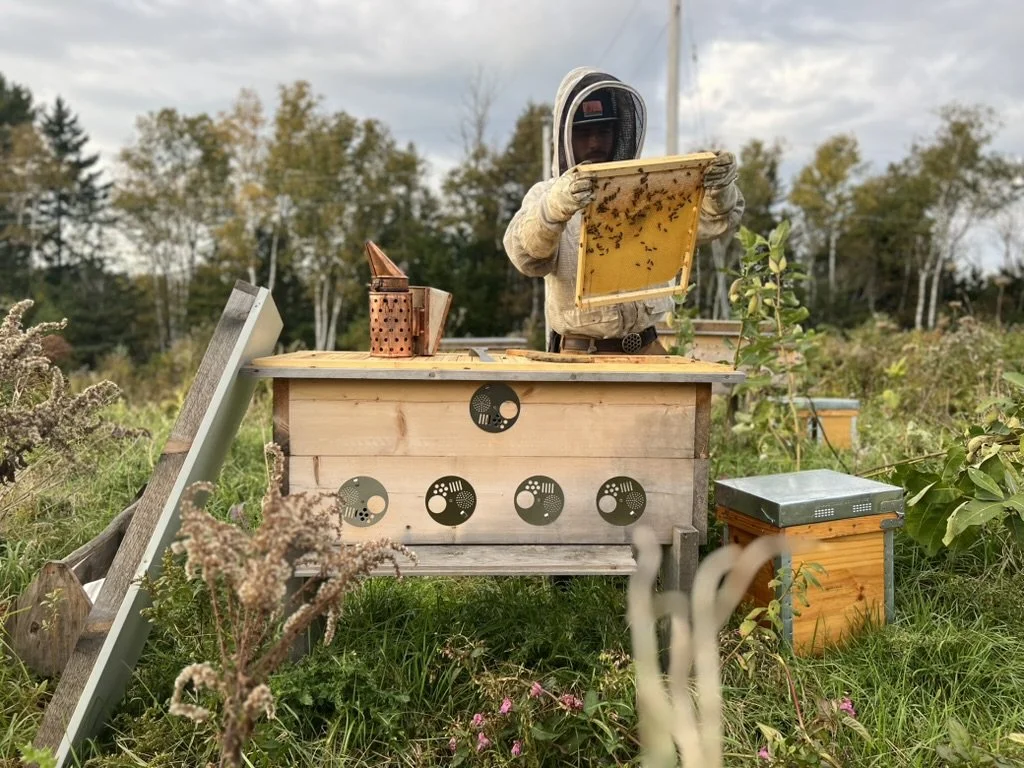
Welcome to North Island Apiaries, a natural beekeeping operation run by Zebadiah Campbell on North Haven Island in Maine. Our honeybees thrive on centuries-old agrarian landscapes, utilizing treatment-free, low-impact methods in Layens Hives.
We are dedicated to sustainable, ethical beekeeping practices that support local ecosystems and deliver high-quality honey and other hive products. We are very passionate about bees and the vital role they play in our ecosystem, and we strive to share our knowledge and love of bees with our community. Thank you for visiting and learning more about North Island Apiaries!


Goldenrod Meadow on Dole Road


Letter to North Haven Land Owners
My Dear North Haven Community,
This letter is coming to you from lover of the natural world, an environmentalist, a beekeeper, a person that cares deeply about our island, and all the living plants an animals that also call it their home.
My name is Zebadiah Campbell. I am an oyster farmer and a beekeeper. I spend all of my days working with the natural flow of the island and I pay close attention to the health of our island ecosystem. Four years ago I started beekeeping because I loved honey. In the last four years, my love for the bees has grown to be much stronger than my love for the honey. Everywhere I go on the island, during foraging season for the bees, primarily May-October, I’m paying attention to what is blooming and what’s available for the bees to put up for winter stores. To name a few: In early spring, the flowering deciduous trees, fruit trees and dandelions. In the summer, clover and milkweed. In the fall, goldenrod and asters. Every single one of these plants, and many many more, are critical for the bees (and many other pollinating insects) survival. For instance, there are over 400 caterpillar species (including monarch) that rely on goldenrod, and without it they can not survive.
Historically, North Haven has been a rich farming society, although there is only a small handful of operating farms here today. We are still graced with many beautiful meadows, once pasture for livestock, or fields used for haying. Bees rely heavily on these meadows to forage for food, and when properly mowed and managed, even a small meadow can produce hundreds of gallons of nectar that bees will evaporate to make delicious honey.
I have found through my observation that most of these island meadows are mowed in the summer, usually sometime between July to early August. This time period is when bees are at their busiest, working all day gathering nectar for winter. When you mow in this time of year, you’re not only killing bees and other foraging insects, but you’re taking away a huge portion of the bees available food for the year.
Now, this is where I ask you, are you willing to change your mowing habits for the pollinators? Here is my recommendation: Just mow twice a year. The timing of these mows is of upmost importance. Mow once in the fall, mid-late October. This gives all of the wildflowers time to go to seed, and in turn, the amount of wildflowers in the meadow next year will grow. Mow once in early spring, late April to early May. This will cut the remainder of the growth from the previous fall, and will give the bountiful dandelions stimulation growth. And after that, let it grow, and watch the pollinators come. We have a small patch of meadow at the oyster farm property, and in the last two years, after timed mowing, goldenrod and milkweed have returned and have begun to spread. The amount of biodiversity that has showed up is truly amazing.
I believe that on North Haven we have a unique opportunity to create a HAVEN for birds, bees, and all other insects, which are the foundation for life. If you are willing to have a conversation with me about mowing and options around meadow or lawn management, please feel free to contact me. If you want to take the pledge immediately, I have bee signs for people to put up in their meadows (or lawns!) indicating that it’s a “Bee North Haven” property. I am also offering a free jar of honey at the end of the year for anyone who is willing to participate.
If you do not have a meadow on your property, there are also things that you can do to help wild pollinators. If you have a lawn, extending the amount of time between mows can allow more time for flowers to bloom and bees to forage. Even many low-growing clovers and dandelions are a gold-mine for bees. A well trimmed lawn is a dead zone for pollinators.
I understand that lawns are great to have for playing sports, for kids to run around and all those fun summer activities. Consider making your lawn smaller and ask yourself, how much lawn do I really need? Once you have figured that out, mow that area, and let the rest of your property grow free so birds, bees and all the important insects also have the ability to thrive on this island.
I hope this letter finds you in good health and well bee-ing!
Sincerely, Zeb Campbell


What MAKES OUR
honey REALLY
REALLY GOOD
-
We never use chemical “treatments” or miticides of any kind. We rely on natural selection, and management practices to keep our bees healthy snd strong. Our hives are free of residues, plastics, and fumigants. What you taste is unfiltered and unheated - raw, living honey with all of its enzymes, pollens, and floral vitality intact.
-
We follow natural beekeeping principles: no plastic foundation, no artificial queen rearing, no migratory trucking. Our hives stay put on the island, sheltered from the stresses of industrial pollination.
-
Our bees live entirely on the nectar and pollen they gather themselves. We never feed sugar, which is common practice elsewhere. They thrive on their own stores of honey, the perfect and complex food they labored to make, and it shows in the depth of flavor and vitality of our colonies.
-
We take only the true surplus. This is honey made without exploitation- never robbed, never rushed. Every spoonful is a gift from the hive, not an extraction from it.
-
Island bees visit hundreds of native and naturalized wildflowers, from clover and milkweed to goldenrod, bayberry, spruce trees, and wild rose. Each bloom contributes a layer of flavor and nutrition. No two seasons taste the same.
-
Our honey is never overheated or pasteurized. We simply strain it to remove bits of wax and let it settle naturally. It’s alive with wild yeasts, enzymes, and pollen: a true whole food, not a processed sweetener.
-
We keep around 100 colonies, just enough to sustain our land and our family. We rely on splits from our hives to grow our apiary, not buying bees in from southern states every year. Our focus is on resilience, not yield.
-
We bottle only in glass, to preserve flavor and purity. No plastic contact, no leaching, no compromise.
-
Each jar of North Island Gold carries the fingerprint of this island landscape: mud flats, salt air, spruce forest, and wildflowers. It’s honey that could only have come from here: pure, elemental, unrepeatable.